
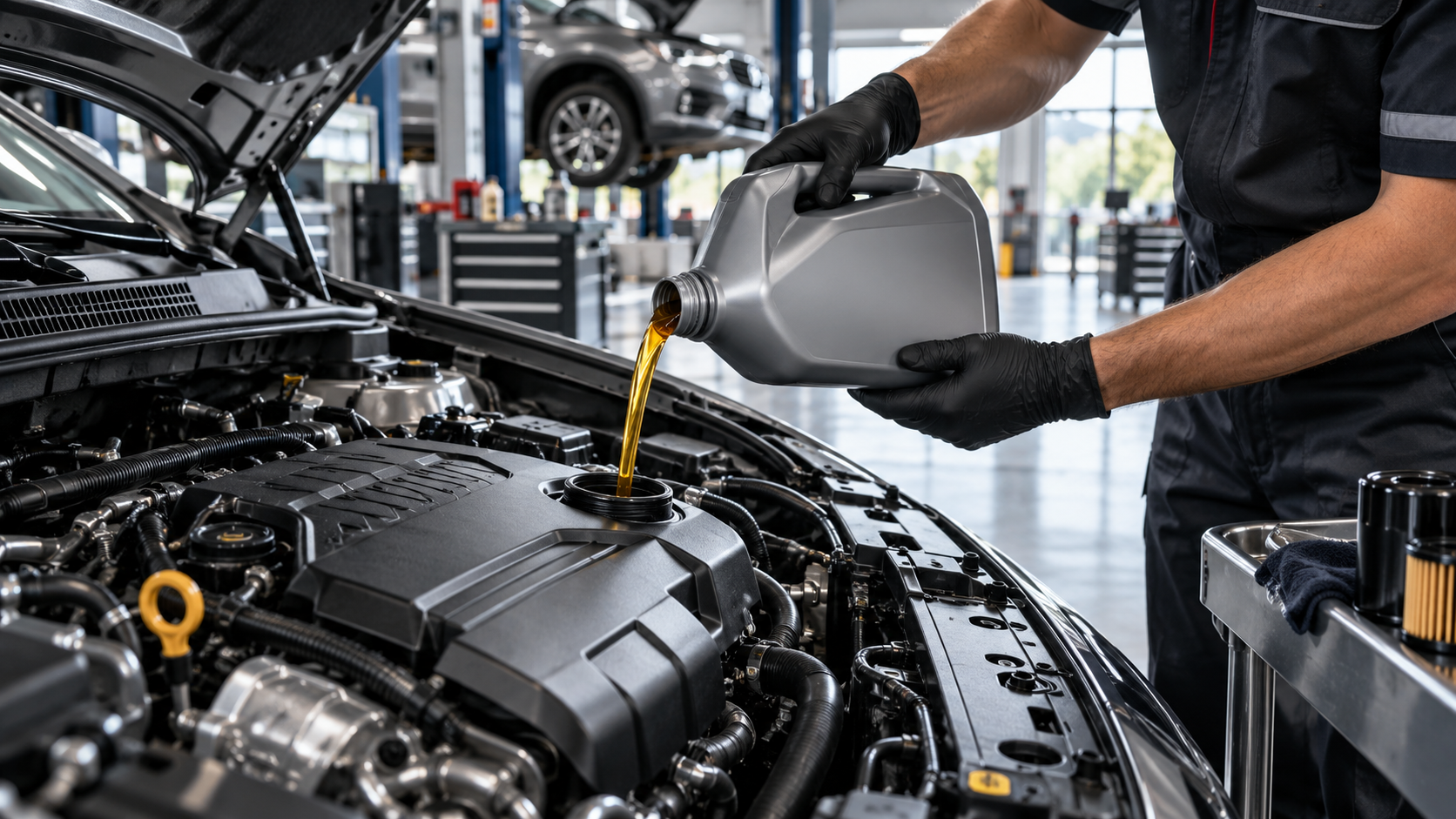

A synthetic oil change sounds simple enough. Drain the old oil, replace the filter, pour in fresh synthetic oil, and move on with your day.
And mechanically, that is basically what happens.
The confusing part starts before anyone touches the drain plug. Full synthetic or synthetic blend? Five thousand miles or ten thousand? Is the expensive oil actually better, or are you paying extra for a fancy label? And why does one shop advertise a synthetic oil change for $59 while another quotes $120 for the same car?
Those are fair questions.
For many newer vehicles sold in the U.S., synthetic motor oil is no longer some premium upgrade reserved for sports cars. It is either recommended or required by the manufacturer. Turbocharged engines, smaller high-output engines, hybrids, vehicles with extended oil-change intervals, and cars driven in temperature extremes commonly use full synthetic oil.
Still, synthetic oil does not mean you can forget about maintenance for a year and a half because someone online said it lasts 15,000 miles.
Your car’s maintenance schedule matters more than generic advice.
The useful way to think about a synthetic oil change is pretty simple: use the correct oil specification, change it when your vehicle calls for it, replace the filter, and do not stretch the interval just because the oil bottle makes impressive claims.
What Is a Synthetic Oil Change?
A synthetic oil change replaces the used engine oil with synthetic motor oil formulated to meet the viscosity and performance standards required by the vehicle.
The service normally also includes a new oil filter.
Some shops add a basic inspection, fluid-level check, tire-pressure check, or maintenance reminder reset. Others keep the service more bare-bones.
The core job remains the same.
- Drain the used motor oil
- Remove and replace the oil filter
- Install a new drain-plug washer when the vehicle calls for one
- Refill the engine with the correct amount of approved synthetic oil
- Check the oil level and inspect for leaks
- Reset the oil-life reminder when applicable
That sounds almost identical to a conventional oil change because it is.
The main difference is the oil itself.
Full Synthetic vs. Synthetic Blend
These terms get mixed together constantly.
Full synthetic motor oil uses highly refined or chemically engineered base oils combined with an additive package designed to control wear, deposits, oxidation, corrosion, viscosity change, and contamination.
A synthetic blend mixes synthetic base oils with conventional mineral oil.
That makes synthetic blend something of a middle ground.
| Oil Type | Typical Characteristics | Common Use |
|---|---|---|
| Conventional | Basic mineral-based motor oil | Some older engines and vehicles where the manufacturer permits it |
| Synthetic blend | Mix of conventional and synthetic base oils | Drivers wanting improved performance without full synthetic pricing |
| Full synthetic | More stable under heat and cold, strong oxidation resistance | Many modern engines, turbo engines, longer factory service intervals |
| High-mileage synthetic | Synthetic oil with an additive package aimed at older engines | Often marketed for vehicles above roughly 75,000 miles |
The words “full synthetic” do not tell you whether a product is correct for your engine.
A $14-per-quart oil in the wrong viscosity or specification can still be the wrong oil.
Look at the owner’s manual or manufacturer maintenance information first.
How Much Does a Synthetic Oil Change Cost in 2026?
For many U.S. passenger vehicles, a full synthetic oil change commonly lands somewhere around $70 to $130 in 2026.
Some smaller engines may cost less, especially with coupons or shop promotions. Larger SUVs, luxury cars, diesel engines, performance vehicles, and engines requiring six, seven, eight, or more quarts can cost considerably more.
The price depends on more than the word “synthetic.”
Oil capacity matters a lot.
If a shop’s advertised service includes five quarts but your engine needs 6.5 quarts, the additional oil is charged separately.
Filter design also matters. A common spin-on filter may be inexpensive. A specialized cartridge filter, housing seal, or premium application can add cost.
| Cost Factor | Why It Changes the Price | What to Ask |
|---|---|---|
| Oil capacity | More quarts mean more product | How many quarts does the quoted price include? |
| Oil specification | Some manufacturer-approved oils cost more | Which exact oil standard will be used? |
| Oil filter | Filter prices vary by vehicle | Is the filter included? |
| Labor | Access differs between vehicles | Are skid-plate or cover removal charges included? |
| Shop fees | Disposal, supply, and local fees may apply | What is the out-the-door total? |
| Location | Labor rates differ across the U.S. | Is this quote specific to my ZIP code? |
So if one shop quotes $79 and another quotes $109, do not assume the first is automatically cheaper.
Ask what each price actually includes.
Why Synthetic Oil Costs More
Synthetic motor oil costs more to manufacture than basic conventional oil.
The base oils are more heavily processed, and the formulation is designed to stay stable through a wide range of temperatures and operating conditions.
The practical benefits can include better cold-flow performance, better resistance to oxidation at high temperatures, and stronger deposit control.
That does not mean synthetic oil makes engines indestructible.
It also does not fix mechanical problems.
If your engine is overheating, leaking coolant into the oil, burning a quart every 500 miles, or running with low oil pressure, upgrading the bottle on the shelf is not the solution.
How Often Should You Get a Synthetic Oil Change?
This is where outdated advice causes the most confusion.
The old “every 3,000 miles” rule is no longer appropriate for many modern vehicles.
At the other extreme, assuming every synthetic oil can safely run 15,000 miles is also a bad shortcut.
Many modern gasoline vehicles have factory oil-change intervals somewhere around 5,000 to 10,000 miles, depending on the engine and driving conditions.
Some vehicles specify shorter intervals. Others go longer.
Your owner’s manual or oil-life monitoring system should be the main reference.
Time matters too.
If you drive very little, the manufacturer may still specify changing the oil after a certain number of months.
Oil does not only age from mileage. Moisture, fuel dilution, repeated cold starts, short trips, and temperature cycles matter too.
Severe Driving Can Shorten the Interval
“Severe service” sounds like something involving a rally car in the desert.
In reality, it can look a lot like normal American driving.
- Frequent short trips where the engine rarely reaches full operating temperature
- Heavy stop-and-go traffic
- Long periods of idling
- Towing or hauling heavy loads
- Driving in dusty conditions
- Regular operation in very hot or very cold weather
- Repeated high-load mountain driving
- Delivery, rideshare, or commercial use
If your driving fits those conditions, your manufacturer may recommend a shorter oil-change interval.
This is why two owners of the same model can reasonably follow different maintenance schedules.
Do Synthetic Oils Really Last Longer?
Generally, yes.
Synthetic oils tend to resist oxidation and viscosity breakdown better than conventional oils.
That is one reason many newer vehicles have longer recommended oil-change intervals than cars from decades ago.
But the oil is only one part of the system.
The filter has to remain effective. Fuel dilution can contaminate the oil. Engines can consume oil between changes. Moisture can accumulate in short-trip vehicles.
And engines differ enormously in how they treat their oil.
So do not take the maximum mileage printed on an oil bottle and automatically apply it to your vehicle.
The manufacturer’s maintenance interval still wins.
What Does 0W-20, 5W-30, or 0W-16 Mean?
Those numbers describe viscosity.
Take 0W-20 as an example.
The number before the “W” describes the oil’s cold-temperature viscosity performance. The second number describes its viscosity at operating temperature.
A 0W-20 oil is not automatically “better” than 5W-30.
It is simply different.
Modern engines are designed around specific viscosity ranges, clearances, oil pumps, variable valve timing systems, turbochargers, and fuel-economy targets.
Using a thicker oil because it “feels safer” is not necessarily smart.
Use the viscosity specified for your vehicle and climate according to the manufacturer’s recommendations.
Oil Specifications Matter as Much as Viscosity
This part often gets ignored.
Two bottles can both say 5W-30 while meeting completely different performance standards.
Depending on the vehicle, the oil may need to meet an API, ILSAC, ACEA, or manufacturer-specific specification.
European vehicles in particular often call for manufacturer approvals that go beyond simply matching viscosity.
If your owner’s manual specifies an approved standard, make sure the oil meets it.
A reputable repair shop should be able to tell you exactly what product is going into the engine.
Does Full Synthetic Oil Improve Fuel Economy?
Sometimes, slightly.
Low-viscosity synthetic oils can reduce internal friction compared with thicker or less advanced formulations, and modern engines are often designed around those oils partly for efficiency.
But a synthetic oil change will not turn a 20-mpg SUV into a 30-mpg SUV.
Tire pressure, vehicle weight, speed, weather, driving style, traffic, aerodynamics, and mechanical condition have much larger day-to-day effects.
Think of fuel economy as a possible small side benefit, not the main reason to switch.
Is Synthetic Oil Better in Cold Weather?
Cold starts are one area where synthetic oil tends to show a real advantage.
Oil thickens when temperatures drop.
Synthetic oils generally maintain better low-temperature flow than basic conventional oils of comparable intended use.
That means oil can circulate more quickly during a cold start, when engine components need lubrication.
This is one reason 0W-grade synthetic oils are so common in modern cars.
If you live in Minnesota, North Dakota, Alaska, or another very cold region, low-temperature performance is not just an interesting specification on the label.
You actually notice winter.
What About Extreme Heat?
Synthetic oil also tends to resist oxidation and breakdown well at high temperatures.
That is useful in turbocharged engines, towing applications, hot climates, and vehicles that spend a lot of time working hard.
Turbochargers are a good example.
Their bearings operate at very high speeds and temperatures. Many modern turbo engines therefore specify synthetic oil that meets strict performance standards.
Again, the answer is not simply “buy the most expensive oil.”
Use what the engine was designed to use.
Should Older Cars Use Synthetic Oil?
There is no rule saying an older engine cannot use synthetic oil.
If the synthetic product meets the viscosity and specifications required by the engine, it can often be used without any problem.
Modern synthetic oil does not magically create leaks in a healthy engine.
But an old engine that already has dried seals or existing leaks may make those issues more noticeable after any oil change.
High-mileage synthetic oils are also available.
These products often contain additive packages designed with older engines in mind.
They are commonly marketed toward vehicles with more than about 75,000 miles.
That mileage number is a marketing guideline, not a mechanical deadline.
Can You Switch Back to Conventional Oil?
If your vehicle manufacturer permits conventional oil, switching between compatible conventional and synthetic products does not inherently damage the engine.
But many newer vehicles specifically require synthetic oil or an oil specification that is usually met by synthetic products.
In that case, switching back just to save a few dollars is not a good idea.
The required specification matters more than whether you prefer one category or another.
Do You Need a New Filter Every Time?
Yes, in normal service the oil filter should be replaced during the oil change.
The filter captures particles and contaminants circulating through the lubrication system.
Putting clean oil through a heavily used old filter defeats part of the point of doing the service.
Most professional synthetic oil change packages include the filter.
Still, ask.
Cheap promotional prices sometimes have limits based on basic filter types, while premium or unusual filters cost extra.
What Is Included in a Good Synthetic Oil Change?
A proper service does not need to involve 27 upsells.
But a few basic steps should happen.
- Verify the correct oil viscosity and specification
- Drain the old oil fully
- Replace the oil filter
- Inspect the drain plug and sealing washer
- Refill with the correct quantity of oil
- Check the final oil level
- Inspect for leaks around the filter and drain plug
- Reset the maintenance or oil-life reminder
- Record the mileage and date
A quick courtesy inspection is useful too.
That might include tires, fluids, lights, belts, or visible leaks.
But inspection does not mean you need to approve every recommended repair immediately.
Do Oil Change Shops Always Use the Oil You Think They Use?
Usually, reputable shops do.
Still, there is nothing wrong with asking.
Ask for the brand, viscosity, and specification.
You can also ask the shop to list the oil on the invoice.
This is especially helpful with vehicles requiring manufacturer-specific approvals.
“Full synthetic 5W-30” is less informative than knowing the product actually meets the specification required by the car.
Dealer vs. Independent Shop vs. Quick-Lube Center
Any of these can perform a perfectly good synthetic oil change.
A dealer has direct access to manufacturer service procedures and is familiar with brand-specific requirements.
An independent repair shop may offer lower pricing and more personal service.
A quick-lube chain can be convenient if you simply need routine maintenance done quickly.
The important question is whether the shop uses the correct oil and filter and follows proper service procedures.
A dealership logo does not make the oil chemically better.
And a small independent shop is not automatically less qualified.
Can You Do a Synthetic Oil Change Yourself?
Yes, if you have safe access to the underside of the car and know the correct procedure.
DIY oil changes can save money, especially on vehicles using expensive oil or large capacities.
But do not crawl under a vehicle supported only by a jack.
Use proper ramps or rated jack stands on a stable surface.
You will also need a drain pan, the correct tools, replacement oil and filter, possibly a new drain-plug washer, and a way to recycle the used oil.
The environmental part matters.
Used motor oil should never go into household trash, onto the ground, or down a drain.
Many auto-parts stores and recycling centers accept used oil.
Common DIY Oil Change Mistakes
Changing oil is simple enough that people sometimes stop respecting the details.
That is how small mistakes become expensive ones.
Installing two filter gaskets by accident can cause a major leak. Overtightening the drain plug can damage the oil pan threads. Forgetting to add oil after draining the old oil is obviously catastrophic.
Using the wrong oil quantity can also create problems.
Too little oil is dangerous.
Too much oil is not good either.
Always check the dipstick or electronic oil-level procedure according to the vehicle instructions after refilling.
What If Your Car Does Not Have a Dipstick?
Some newer vehicles use electronic oil-level monitoring instead of a traditional dipstick.
The procedure may require the engine to reach operating temperature, the car to sit level, and the driver to wait a specific amount of time before checking the level through the dashboard menu.
This is one of those moments when the owner’s manual is more useful than guessing.
Do not add another quart just because you cannot find a dipstick.
Why the Oil Light Is Not an Oil Change Reminder
Drivers sometimes confuse these two warnings.
An oil-life or maintenance reminder tells you routine service is due.
An oil-pressure warning light can mean the engine has dangerously low oil pressure.
Those are not the same thing.
If the red oil-pressure warning appears while the engine is running, especially with noise from the engine, shut the vehicle down safely and investigate the problem.
Do not keep driving because you planned to get an oil change next weekend.
Should You Flush the Engine During an Oil Change?
Usually, routine engine flushing is not necessary on a properly maintained vehicle.
Modern motor oils already contain detergents and dispersants designed to control deposits.
If an engine has serious sludge or contamination, blindly pouring in a strong flushing chemical can create its own problems.
Follow manufacturer recommendations and diagnose the reason for sludge instead.
Regular oil changes with the correct oil are much less dramatic and generally much more useful.
What Happens If You Wait Too Long?
Oil slowly accumulates contamination and its additives become depleted.
Extended neglect can contribute to deposits, sludge, wear, reduced lubrication, and in extreme cases serious engine damage.
Turbocharged engines can be particularly unforgiving of poor oil maintenance.
One late oil change does not automatically destroy an engine.
But repeatedly stretching a 7,500-mile interval to 14,000 miles because “it’s synthetic” is not a maintenance strategy.
What If Your Oil Looks Black?
Dark oil does not automatically mean the oil is ruined.
Motor oil is designed to hold contaminants in suspension, so it can darken relatively quickly during normal use.
Color alone is a poor way to determine when oil needs replacement.
Mileage, time, operating conditions, the oil-life monitor, and manufacturer recommendations are more useful.
On the other hand, metallic particles, coolant contamination, a strong fuel smell, or unusual oil consistency deserve investigation.
Does Synthetic Oil Stop Oil Consumption?
No.
An engine that burns oil because of worn piston rings, valve seals, turbocharger problems, or another mechanical issue may continue consuming oil regardless of whether the oil is synthetic.
Some engines normally consume a small amount between services.
Check the level periodically rather than assuming a longer oil-change interval means you never need to open the hood.
This is particularly important on vehicles known to use oil between changes.
Can Low Oil Damage an Engine Before the Next Change?
Absolutely.
An engine can be low on oil long before the scheduled service date.
If an engine burns or leaks oil, waiting for the maintenance reminder without checking the level can be risky.
Check the oil periodically according to the vehicle instructions.
Long intervals make that habit even more important, not less.
Synthetic Oil Change for Hybrids
Many hybrid vehicles use low-viscosity full synthetic motor oil.
The gasoline engine may run less often than in a conventional car, but that does not mean the oil can stay in forever.
Hybrid engines experience repeated starts and stops, and the manufacturer still specifies maintenance intervals.
Follow the hybrid’s own schedule rather than applying generic gasoline-car advice.
And yes, a hybrid can have both a sophisticated electric drivetrain and a very ordinary engine oil drain plug.
Synthetic Oil Change for Turbocharged Engines
Turbocharged engines are common across the U.S. market now, from compact crossovers to pickup trucks.
Turbochargers operate under high heat and rely on engine oil for lubrication.
That makes correct oil specification and regular maintenance especially important.
If your turbo engine calls for full synthetic oil, consider that a requirement rather than an optional premium service.
Turbo repairs cost dramatically more than the price difference between oil types.
How to Save Money on a Synthetic Oil Change
You do not have to pay the highest menu price every time.
Service chains, dealerships, tire stores, and independent shops frequently run oil-change specials.
Before booking, check the details carefully.
A $49 synthetic oil change may include only five quarts. Your vehicle may need seven.
A coupon may also exclude specialty filters, diesel engines, European oil specifications, or oversized vehicles.
The best comparison is the final price for your exact car.
Questions to Ask Before Booking
- What is the total synthetic oil change price for my exact vehicle?
- How many quarts are included?
- What oil viscosity and specification will you use?
- Is the oil filter included?
- Does my vehicle require a premium or specialty filter?
- Are disposal, shop-supply, or other fees added?
- Will you reset the oil-life monitor?
- Will the service appear on my maintenance record?
- How long should the appointment take?
Those questions remove most surprises from the invoice.
FAQ
How much does a synthetic oil change cost in 2026?
For many U.S. passenger cars, a full synthetic oil change commonly costs around $70 to $130. Smaller engines and coupons can bring the price lower, while large-capacity engines, luxury vehicles, specialty filters, and manufacturer-specific oils can push the total higher.
How often should I get a synthetic oil change?
Follow your vehicle manufacturer’s schedule or oil-life monitor. Many modern vehicles fall somewhere around 5,000 to 10,000 miles, but the correct interval depends on the engine, oil specification, driving conditions, and time. Severe driving can require more frequent service.
Is full synthetic oil really better?
Full synthetic oil generally offers stronger resistance to oxidation, better low-temperature flow, and stable performance under high heat. Whether you need it depends on your engine. Many modern vehicles require synthetic oil rather than simply recommending it as an upgrade.
Can I switch from conventional oil to synthetic?
Usually, yes, if the synthetic oil meets the viscosity and performance specifications required by the engine. Switching to synthetic does not normally harm a healthy engine. Always follow the manufacturer’s oil requirements.
Can synthetic oil last 15,000 miles?
Some oil products advertise very long service capability, but that does not automatically mean your vehicle should run 15,000 miles between changes. Follow the manufacturer’s maintenance interval, because engine design, driving conditions, oil contamination, filter life, and oil consumption also matter.
Do I need a new oil filter with synthetic oil?
Yes. The oil filter should normally be replaced during every scheduled oil change. A clean filter helps remove contaminants from the new oil as it circulates through the engine.
Is a synthetic oil change worth the extra money?
If your vehicle requires full synthetic oil, then yes – it is part of proper maintenance. If synthetic is optional, the benefits can still make sense for cold climates, high heat, turbo engines, demanding driving, or longer manufacturer-approved service intervals. The correct choice depends on the vehicle rather than price alone.
Conclusion
A synthetic oil change is not complicated.
The hard part is ignoring all the conflicting advice around it.
You do not need to change every modern car at 3,000 miles.
You also should not automatically drive 15,000 miles because the word “synthetic” appears on the bottle.
The vehicle manufacturer already did most of the homework for you.
Use the recommended viscosity. Make sure the oil meets the required performance specification. Follow the maintenance interval or oil-life monitor. Shorten the interval when the manufacturer calls for severe-service maintenance.
And check the oil level between services.
That last step is easy to forget. Longer oil-change intervals do not protect an engine that quietly burns two quarts before the next service.
For many U.S. drivers in 2026, a full synthetic oil change costs roughly $70 to $130, although capacity, vehicle design, filters, local labor rates, and manufacturer-specific oils can change the total considerably.
Get the price for your actual car rather than relying on a generic advertisement.
If you are comparing shops, ask what oil they plan to use and how many quarts the quoted price includes. Make sure the filter is included. Ask about extra fees.
A cheap advertised oil change is not especially cheap if the invoice doubles after additional oil, a filter upgrade, and shop charges are added.
Full synthetic oil earns its place because modern engines ask a lot from their lubricant.
Turbochargers run hot. Start-stop systems cycle engines repeatedly. Low-viscosity oils need to flow quickly in winter while still protecting components at operating temperature. Hybrids start and stop their engines in ways older cars never did.
Synthetic oils are well suited to that job.
But oil is still maintenance, not magic.
If the engine leaks, repair the leak. If it burns oil, check the level. If an oil-pressure warning comes on, stop treating it like a routine service reminder. If the manufacturer specifies a certain approval, use an oil that actually meets it.
The smartest synthetic oil change is not necessarily the most expensive one.
It is the one performed with the right oil, the right filter, the right quantity, and at the right time.
Do that consistently, and oil changes become what they should be: boring, predictable maintenance rather than the beginning of an expensive engine story.