

Your car is driving straight. Mostly.
Maybe the steering wheel sits a little off-center. Maybe the vehicle gently drifts toward the shoulder. Or perhaps you bought new tires six months ago and one edge already looks suspiciously worn.
These are the kinds of small clues that make wheel alignment worth checking.
A wheel alignment does not literally mean a mechanic twists your wheels until they look straight. The service involves measuring and adjusting specific suspension angles so the tires sit and roll in the positions intended by the vehicle manufacturer.
Those angles affect steering, handling, stability, and tire wear.
And the difference can be tiny. Alignment specifications are measured in degrees, often fractions of a degree. You can look at a tire and think it appears perfectly straight while an alignment machine shows that it is outside specification.
For U.S. drivers, alignment becomes especially relevant after hitting a serious pothole, replacing suspension or steering parts, installing new tires, or noticing uneven tire wear.
It is not something every car automatically needs every few months. But when alignment is wrong, ignoring it can turn a relatively simple adjustment into a set of prematurely worn tires.
What Is Wheel Alignment?
Wheel alignment is the process of measuring the angles of the wheels relative to the vehicle and road surface, then adjusting the suspension where the design allows.
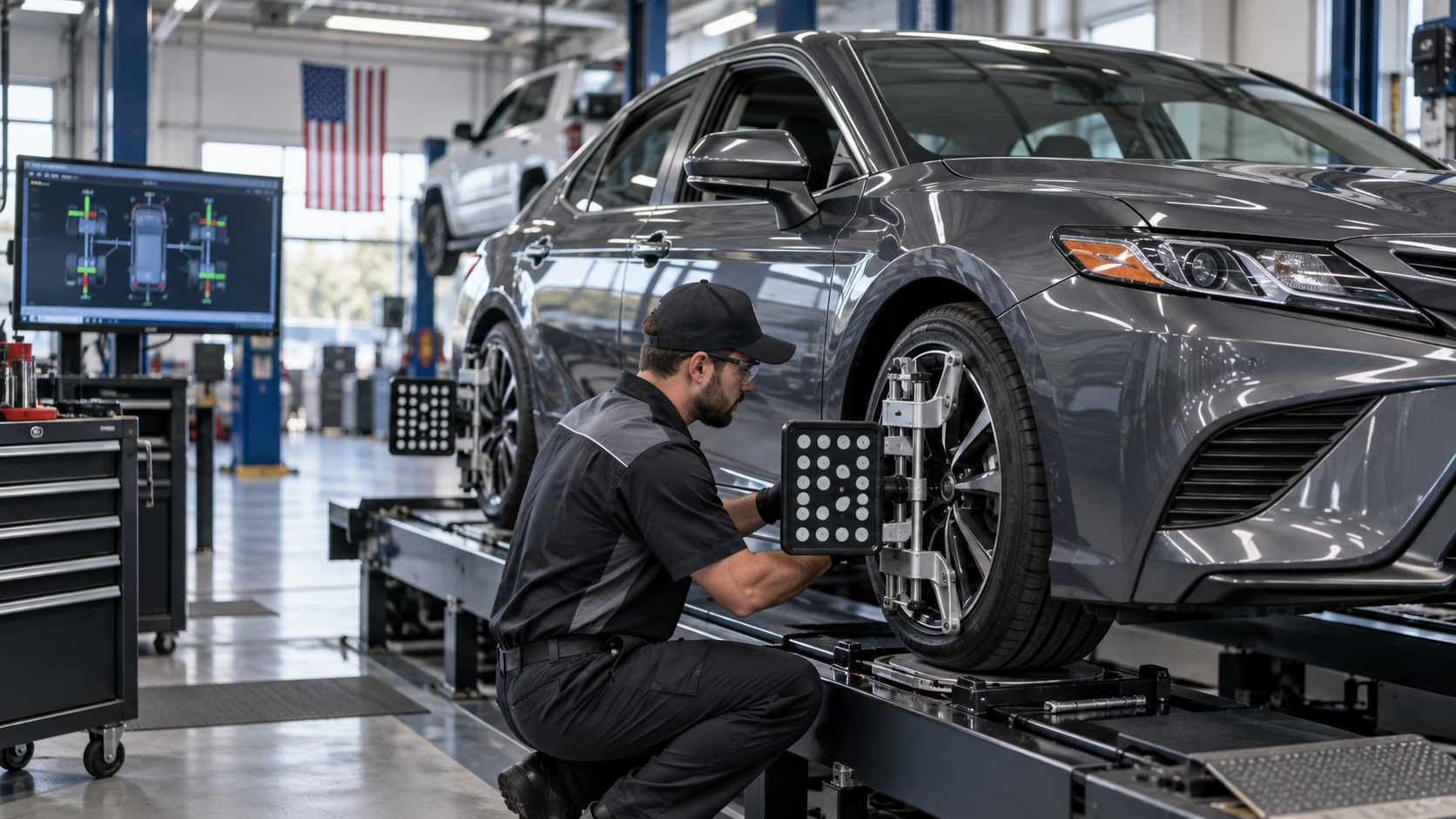
The technician normally puts the car on an alignment rack and attaches precision sensors or targets to the wheels.
The machine compares the measurements with specifications for the exact make, model, year, and sometimes suspension configuration.
The three alignment terms you will hear most often are camber, toe, and caster.
They sound technical, but the basic ideas are fairly simple.
Camber, Toe, and Caster Without the Engineering Lecture
| Alignment Angle | What It Describes | What Incorrect Alignment Can Cause |
|---|---|---|
| Camber | The inward or outward tilt of the tire when viewed from the front | Wear concentrated on the inner or outer edge of the tire |
| Toe | Whether the fronts of paired tires point slightly toward or away from each other | Rapid feathered tire wear, unstable tracking, or steering issues |
| Caster | The forward or backward tilt of the steering axis when viewed from the side | Poor steering return, pulling, or reduced straight-line stability |
Camber is easy to picture.
Imagine looking directly at the front of the car. If the top of the tire leans inward toward the vehicle, that is negative camber. If it leans outward, that is positive camber.
Some negative camber can be completely normal. Performance cars may intentionally run more of it because of the way the tire behaves while cornering.
The problem is not simply that an angle is positive or negative. The question is whether it matches the manufacturer’s specification.
Toe describes the direction the tires point when viewed from above. If the fronts of the two tires point slightly toward each other, that is toe-in. If they point away from each other, that is toe-out.
Toe problems can destroy tires surprisingly quickly because the tires are essentially being dragged slightly sideways while the car moves forward.
Caster is less visible but important for steering feel and stability. It helps the steering return toward center after a turn and contributes to how firmly the vehicle tracks down the road.
Signs Your Car May Need a Wheel Alignment
Alignment problems do not always announce themselves dramatically.
Sometimes the car still feels perfectly usable. You just notice one small thing is not quite right.
- The vehicle consistently pulls or drifts to one side on a reasonably flat road.
- The steering wheel sits crooked while the car travels straight.
- The tires show noticeably different wear from one edge to the other.
- The tread feels feathered, with one side of a tread block smoother than the other.
- The car feels unusually nervous or unwilling to track straight.
- You recently hit a major pothole, curb, or road hazard.
- Steering or suspension components were recently replaced.
- New tires are wearing unevenly much sooner than expected.
- The steering no longer returns toward center as naturally after a turn.
There is one important nuance here.
A car drifting slightly on a crowned road does not automatically mean the alignment is wrong.
Many U.S. roads are intentionally sloped toward the shoulder so rainwater drains away. That can create a mild tendency for a car to move toward the lower side.
Strong or consistent pulling on different roads is more meaningful.
A Crooked Steering Wheel Is One of the Easiest Clues
You are driving down a straight interstate, but the steering wheel logo looks like it is leaning five degrees to the left.
That is worth investigating.
An off-center steering wheel often appears when front toe settings are not balanced correctly, although other suspension or steering issues can contribute.
The car may technically travel straight, but the steering wheel itself no longer sits where it should.
During a proper wheel alignment, the technician centers and holds the steering wheel while setting the relevant angles.
If you pick up the car after an alignment and the steering wheel remains noticeably crooked, tell the shop.
Uneven Tire Wear Can Cost More Than the Alignment
This is where alignment stops being a minor steering issue and becomes a money issue.
A modern set of tires can cost hundreds or well over a thousand dollars depending on the vehicle.
If poor toe or camber destroys one edge of those tires while plenty of tread remains elsewhere, you may have to replace them long before the tread would normally be worn out.
Imagine a tire with healthy tread across 80% of its width but nearly bald rubber along the inside shoulder.
That tire is not “mostly good.”
The badly worn section still matters.
This is why tire shops often recommend checking alignment when installing a new set, especially if the old tires show uneven wear.
You do not necessarily need an alignment every single time you buy tires. But putting expensive new tires on a car that already has obvious alignment-related wear is a bit like buying new shoes and immediately walking with a stone inside one of them.
How Much Does a Wheel Alignment Cost?
Prices vary by region, shop, vehicle, and alignment type.
For many U.S. passenger cars, a standard four-wheel alignment commonly lands somewhere around the low hundreds of dollars, with roughly $100 to $200 being a useful planning range at many independent shops and tire centers.
Luxury vehicles, performance cars, modified suspensions, difficult adjustments, or dealer service can cost more.
Some shops advertise very inexpensive alignment specials. Those can be legitimate, but check what the price includes.
A measurement-only inspection is not the same as a full adjustment. And if worn suspension parts prevent the vehicle from holding alignment, those repairs will be separate.
Many national tire chains also sell lifetime alignment packages, where the owner pays more initially and can return for future alignment checks or adjustments under the program’s terms.
Whether that is worthwhile depends on how long you plan to keep the car and how frequently your roads test the patience of your suspension.
Two-Wheel Alignment vs. Four-Wheel Alignment
You may still see the phrase “front-end alignment.”
Historically, many vehicles only needed significant adjustment at the front wheels.
Modern cars are more likely to be checked using all four wheels.
| Service Type | What Is Checked | Where It Makes Sense |
|---|---|---|
| Front-end / two-wheel alignment | Primarily front wheel angles | Some older vehicles or designs with limited rear adjustment |
| Four-wheel alignment | All four wheels are measured and related to the vehicle centerline | Most modern passenger cars, SUVs, and independent rear suspensions |
| Thrust-angle alignment | Front wheels are aligned relative to the direction the rear axle points | Vehicles with a solid or non-adjustable rear axle |
| Performance alignment | Angles are set for specific handling goals within suitable limits | Sports cars, track use, or modified suspension setups |
A modern alignment machine usually measures all four corners even when not every rear angle is adjustable.
That matters because the front wheels need to be aligned in relation to where the rear wheels are actually pointing.
What Happens During a Wheel Alignment?
The process normally begins before the alignment machine.
A technician may inspect tire pressures, tire condition, suspension joints, steering parts, ride height, and obvious wheel or suspension damage.
That inspection matters.
You cannot properly align a car with a loose tie rod end and expect the numbers to remain correct. The technician could set it perfectly on the rack, drive off the machine, and have the looseness immediately change the effective geometry again.
After inspection, the vehicle is positioned on the alignment rack.
Sensors or optical targets are attached to the wheels. The machine measures the existing angles and compares them with factory specifications.
The technician then adjusts whichever angles the vehicle allows.
Toe is commonly adjustable. Camber and caster adjustability varies widely between vehicles. Some cars have factory adjustment points, while others may require specialized components if an angle is outside specification.
At the end, many shops provide a printout showing the measurements before and after adjustment.
Those Red and Green Numbers on the Alignment Sheet
If you receive an alignment printout, it may look like someone handed you a colorful geometry exam.
Usually, green means the measurement is within the manufacturer’s specified range. Red generally means it falls outside that range.
But do not obsess over color alone.
A vehicle can technically fall inside specification while still having an undesirable left-to-right difference that contributes to pulling. An experienced technician looks at the relationship between the numbers, not just whether every box turned green.
If something remains outside specification after the service, ask why.
There may be no factory adjustment for that angle, or a bent or worn component may need repair first.
Can a Pothole Knock the Alignment Out?
Yes.
A hard pothole impact can shift alignment, damage a tire, bend a wheel, or affect steering and suspension components.
But every pothole does not automatically require a wheel alignment.
If you hit one and nothing changes – steering remains centered, the vehicle drives normally, and tire wear stays even – an immediate alignment may not be necessary.
If the steering wheel suddenly sits differently afterward, the car starts pulling, or you feel a new vibration, get the vehicle inspected.
And remember: vibration is not a classic alignment symptom by itself.
A pothole can bend a rim or damage a tire, creating vibration even if the alignment angles remain acceptable.
Wheel Alignment and Wheel Balancing Are Not the Same Thing
These two services get confused constantly.
Wheel alignment concerns suspension geometry and the direction the wheels point.
Wheel balancing deals with weight distribution around the tire-and-wheel assembly.
An out-of-balance wheel often causes vibration at certain speeds.
An alignment problem more commonly causes pulling, a crooked steering wheel, or uneven tire wear.
You can need both services at the same time.
For example, after buying four new tires, the shop will normally balance each tire-and-wheel assembly. If the old tires also showed uneven alignment-related wear, an alignment check may make sense too.
Does Steering Wheel Vibration Mean Bad Alignment?
Not usually.
Alignment can contribute to unusual handling, but a vibration felt through the steering wheel is more often associated with wheel balance, tire damage, bent wheels, worn suspension parts, brake issues, or other mechanical causes.
A vibration that appears primarily around 60 or 70 mph often makes technicians think about tire and wheel balance first.
A vibration while braking may point toward the braking system.
A vibration during acceleration can have yet another cause.
This is why describing exactly when the symptom happens is more helpful than walking into a shop and saying, “I need an alignment.”
Tell the technician what the car is doing.
When Should You Get an Alignment After Suspension Work?
Many steering and suspension repairs change or disturb wheel geometry.
If a repair involves parts that affect wheel position, an alignment is commonly part of the job or should follow it.
- Tie rods or tie-rod ends
- Control arms
- Ball joints on certain suspension designs
- Struts or some shock-and-spring assemblies
- Steering racks
- Adjustable suspension links
- Subframe work
- Ride-height changes
- Lowering springs or coilovers
- Some wheel-bearing or knuckle repairs
Ask the shop whether alignment is included in the repair quote.
Do not assume it is.
New Tires: Alignment Before or After?
If the old tires show abnormal wear, diagnose the cause before letting the same thing happen to the new ones.
The alignment itself is normally performed with the new tires installed or with tires that are in suitable condition.
Badly worn tires can affect how the car behaves during testing.
A common sequence is:
Inspect suspension, install new tires, balance them, then perform the alignment.
If worn suspension parts are found, repair those first.
No point carefully adjusting alignment around a component that is about to be replaced next week.
How Often Should You Get a Wheel Alignment?
There is no universal U.S. rule saying every vehicle needs an alignment at a fixed mileage.
Some shops suggest checking annually. Others recommend checking during tire replacement, after suspension work, after a major impact, or whenever symptoms appear.
That symptom-based approach makes sense.
If you drive on rough city streets full of potholes, your suspension experiences a very different life from a vehicle that spends its days cruising smooth suburban highways.
Consider an alignment check periodically if the car sees hard road conditions, but do not assume the angles must be adjusted simply because a year has passed.
Measuring alignment and actually changing it are two different things.
Can Alignment Improve Fuel Economy?
Correct alignment can reduce unnecessary rolling resistance when badly misaligned wheels are dragging across the road instead of rolling cleanly.
So yes, severe misalignment can hurt efficiency.
But do not expect a wheel alignment to suddenly add 10 mpg to a normally functioning vehicle.
The more immediate benefits are typically proper tire wear, predictable steering, and stable tracking.
If fuel economy has suddenly dropped, tire pressure, driving conditions, temperature, mechanical issues, and driving style deserve attention too.
Can You Do a Wheel Alignment at Home?
Technically, people do.
Race teams and experienced enthusiasts often measure toe, camber, and other geometry using specialized home setups.
For the average driver, however, professional alignment equipment is easier and far more precise.
Eyeballing the front tires from the driveway is not a wheel alignment.
Neither is measuring the distance between tire treads with a tape measure and assuming the entire suspension geometry is now perfect.
A DIY toe check can sometimes identify a major problem, but a modern alignment rack provides measurements for all four wheels and compares them with exact manufacturer specifications.
What If the Shop Says Your Car Cannot Be Aligned?
That sounds alarming, but it can mean several different things.
Maybe a suspension component is bent.
Maybe bushings are badly worn. Maybe the subframe shifted after an impact. Maybe the vehicle has no factory adjustment for the angle that is out of specification.
Modified vehicles can create another complication.
Lowering a car changes suspension geometry. If the factory adjustment range cannot compensate, aftermarket camber bolts, adjustable control arms, links, or other components may be required.
Ask the technician to show you which measurement cannot be corrected and what mechanical issue is causing it.
“It won’t align” should be the beginning of the explanation, not the end.
Alignment After a Collision
A minor fender bender does not always affect alignment.
A harder impact involving a wheel, curb, suspension corner, or significant body damage certainly can.
Body shops often check alignment during repairs when suspension geometry may have been affected.
If a vehicle returns from collision repair and pulls, sits unevenly, or has a newly crooked steering wheel, contact the repair facility rather than assuming this is a normal post-accident quirk.
It is not something you should simply get used to.
Alignment and Advanced Driver Assistance Systems
Modern vehicles add another layer to the conversation.
Many cars now use forward-facing cameras, radar, steering-angle sensors, and other equipment for lane-keeping, adaptive cruise control, automatic emergency braking, and related driver-assistance features.
Depending on the vehicle and repair performed, some steering, suspension, windshield, collision, or alignment work may be followed by calibration procedures.
This is highly vehicle-specific.
If your car has advanced driver-assistance systems, ask whether the alignment or related repair requires a steering-angle reset or ADAS calibration according to manufacturer procedures.
A good shop should know the difference between mechanical wheel alignment and electronic sensor calibration.
How Long Does a Wheel Alignment Take?
A straightforward alignment commonly takes around an hour.
Some vehicles are faster. Others take considerably longer.
Rusty adjustment hardware can slow things down. So can seized tie rods, aftermarket suspension, damaged components, or a vehicle that needs additional diagnosis.
If the technician discovers a loose ball joint or worn tie rod during the inspection, the alignment may need to wait until the repair is made.
That is not the shop trying to make the visit inconvenient.
Alignment depends on the suspension holding the wheel firmly in the position where it was adjusted.
How to Protect Your Alignment
You cannot avoid every pothole in America.
Some of them appear to have their own ZIP code.
But basic driving and maintenance habits can help.
- Slow down when road damage is visible instead of hitting it at full speed.
- Avoid repeatedly bumping curbs while parking.
- Keep tire pressure at the vehicle manufacturer’s recommended level.
- Rotate tires according to the tire or vehicle maintenance schedule.
- Inspect tire tread periodically for uneven wear.
- Have steering or suspension looseness checked promptly.
- Get the alignment measured after major suspension repairs.
- Recheck alignment if a severe pothole or curb strike changes how the car drives.
One more habit helps more than people expect: look at your tires.
You do not need mechanical training.
If one shoulder is disappearing much faster than the rest of the tread, something deserves attention.
How to Choose a Shop for Wheel Alignment
Alignment equipment matters, but the technician matters too.
A sophisticated alignment rack cannot repair worn suspension on its own.
Look for a shop that inspects the vehicle before blindly adjusting numbers.
Ask whether you will receive a before-and-after alignment report.
Find out whether the quoted price includes adjustment of all factory-adjustable angles or whether certain corrections cost extra.
If your vehicle is modified, tell them beforehand.
Lowering springs, coilovers, lift kits, oversized wheels, adjustable arms, and performance alignment targets can change the job substantially.
And if you drive a high-performance car, ask whether the shop regularly works with that type of suspension.
Do Cheap Alignment Specials Make Sense?
Sometimes.
A promotional alignment can be a perfectly normal way for a tire shop or service center to bring customers in.
The issue is not the discount itself.
The question is what happens once the car reaches the rack.
If the initial price suddenly expands into mandatory add-ons that were never mentioned, ask for an explanation.
On the other hand, if the technician finds a genuinely worn tie rod, cracked bushing, or bent component, that is not an “upsell” just because it costs more.
The best defense is information.
Ask to see the damaged part or the alignment measurement that cannot be corrected.
What Should You Do After an Alignment?
Drive the car.
That sounds obvious, but pay attention.
The steering wheel should sit reasonably centered on a flat road. The car should track predictably. There should be no new noises or unusual steering behavior.
Keep in mind that road crown and crosswinds can still influence the vehicle.
If the steering wheel remains clearly crooked or the car strongly pulls after service, go back to the shop.
Also keep checking tire wear over the next few thousand miles.
An alignment corrects geometry. It cannot restore rubber that was already worn unevenly.
FAQ
How much does a wheel alignment cost?
For many U.S. passenger vehicles, a standard four-wheel alignment commonly costs roughly $100 to $200, although pricing varies by region, vehicle, shop, suspension design, and whether additional repairs or adjustments are required.
How do I know if my car needs a wheel alignment?
Common clues include uneven tire wear, a steering wheel that sits off-center, persistent pulling on relatively flat roads, feathered tread, or a noticeable change after hitting a pothole or curb. Suspension repairs can also make an alignment necessary.
How often should wheel alignment be done?
There is no universal interval for every vehicle. Alignment is worth checking when symptoms appear, after certain suspension or steering repairs, after a significant impact, when installing tires that replace unevenly worn ones, or periodically if you regularly drive on rough roads.
Is wheel alignment the same as tire balancing?
No. Alignment adjusts suspension geometry and wheel angles. Balancing corrects uneven weight distribution in the tire-and-wheel assembly. Vibration is commonly associated with balance problems, while pulling and uneven wear more often suggest alignment or suspension issues.
Can a pothole cause alignment problems?
Yes. A hard impact can change alignment or damage wheels, tires, and suspension parts. If the steering changes, the car begins pulling, or new tire wear appears after a pothole hit, have the vehicle inspected.
Should I get an alignment with new tires?
It is a good idea to check alignment if the old tires wore unevenly, the steering is off-center, or the car has known alignment symptoms. An alignment is not automatically required with every tire purchase, but protecting a new set from abnormal wear can save money.
How long does a wheel alignment take?
A straightforward alignment often takes about an hour. Rusted adjustment hardware, damaged suspension parts, aftermarket components, or additional repairs can make the process longer.
Conclusion
A wheel alignment is one of those services you barely notice when everything is correct.
The car simply drives straight.
The steering wheel sits where it should. The tires wear evenly. You turn into a corner, straighten the wheel, and keep going.
Nothing dramatic happens.
That is the goal.
Problems usually appear slowly. A steering wheel starts sitting slightly to one side. One tire develops more wear on its inner shoulder. The car seems to wander a little more on the highway.
Those small clues are worth paying attention to because tires are expensive and alignment problems rarely improve by themselves.
The key thing to remember is that wheel alignment is about suspension geometry, not simply whether the wheels look straight.
Camber, caster, and toe are measured precisely against the manufacturer’s specifications. A proper alignment also depends on the steering and suspension being mechanically sound.
If a tie rod is loose or a control arm is damaged, adjustment alone is not the fix.
And if your steering wheel vibrates, do not automatically assume alignment is responsible. Wheel balance, tire damage, bent wheels, brakes, and suspension components can all create vibration.
Describe the symptom rather than diagnosing the car before you arrive at the shop.
If you are buying new tires, inspect the old ones first. Uneven wear can tell a useful story. If you just hit a large pothole and the car suddenly drives differently, have it checked. If suspension parts were replaced, ask whether alignment is included in the repair.
For many U.S. drivers, a four-wheel alignment is a relatively small expense compared with replacing tires early.
And once the service is finished, ask for the before-and-after printout.
You do not need to become an expert in fractions of a degree.
You just want to know that the vehicle was measured, adjusted where necessary, and left within the proper specifications.
Then drive it.
If the steering feels natural, the wheel sits straight, and the car tracks cleanly down the road, you probably will not think about alignment again for quite a while.
Which is exactly how it should be.